
For medical office visits, we are a cash-only practice. Our initial medical office visit is $300 and follow-up medical appointments are $200. Please feel free to contact us at the number listed below if you have any questions, or would like to schedule an appointment.
Rosacea (pronounced “roh-ZAY-sha”) is a chronic and potentially life-disruptive disorder primarily of the facial skin, often characterized by flare-ups and remissions. Rosacea affects mostly adults, usually people with fair skin, between the ages of 30 and 60. Many have observed that it typically begins any time after age 30 as a redness on the cheeks, nose, chin or forehead. It typically first appears as a flushing or redness that comes and goes. In some cases, rosacea may also occur on the neck, chest, scalp or ears. Sometimes referred to Acne Rosacea or misdiagnosed as adult acne, Rosacea has no specifically known cause. Find out more about our options to treat rosacea here: Rosacea Treatment
I’d like to thank Dr. Pilest for treating the most severe case of Rosacea I’ve seen and experienced. He treated me with such understanding and had me ready for a very important “Generation” family photo in just 1 week. I am very impressed. Dr. Pilest can help anyone in the war on this painful and unsightly problem. The pictures turned out great!”
Joyce McBroom
Over time, the redness becomes ruddier and more persistent, and visible blood vessels (telangiectasia) may appear. Bumps (papules) and pimples (pustules) often develop, and in some people the eyes feel irritated and appear bloodshot. In other cases, the nose may become swollen and enlarged from excess tissue. Without treatment, each of these potential signs and symptoms may progress from mild to moderate to severe.
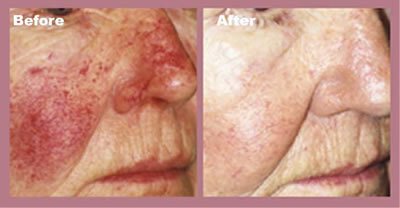
Photo Source Candela
Learn about Treatment of Facial Rosacea with Vbeam Laser
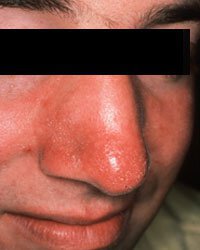
Subtype 1: Facial Redness (Erythematotelangiectatic Rosacea)
Rosacea sufferers typically experience flushing and persistent facial redness. Small blood vessels may become visible in some patients, and stinging, burning, swelling and roughness or scaling may also occur.
Subtype 2: Bumps and Pimples (Papulopustular Rosacea)
Rosacea sufferers typically experience flushing and persistent facial redness. Small blood vessels may become visible in some patients, and stinging, burning, swelling and roughness or scaling may also occur.
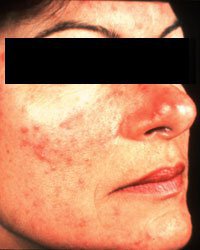
Subtype 3: Enlargement of the Nose (Phymatous Rosacea)
Rosacea may be associated with enlargement of the nose from excess tissue, a condition known as rhinophyma.This may include thickening of the skin and irregular surface nodules, which in rare cases may also develop in areas other than the nose.
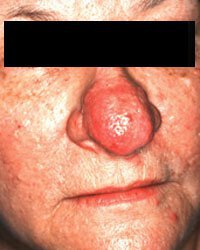
Subtype 4: Eye Irritation (Ocular Rosacea)
Rosacea affects the eyes in many patients, and may result in a watery or bloodshot appear-ance, irritation and burning or stinging. The eyelids may also become swollen, and styes are common.
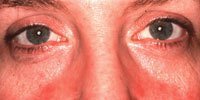
Acknowledgements: Patient photos were supplied by Dr. Joseph Bikowski, assistant clinical professor of Dermatology, University of Pittsburgh; and Dr. Jerome Z. Litt, assistant clinical professor of Dermatology, Case Western Reserve University thru the National Rosacea Society.
We love our patients at Total Dermatology! Read what our satisfied patients have to say about their experiences with Dr. Pilest and our team.


*Individual Results May Vary
Schedule your consultation with board-certified dermatologist Dr. Nissan Pilest at Total Dermatology in Irvine, CA today by calling (949) 727-3800.
*Individual Results May Vary
When it comes to your skin and your health, it really is all about what’s best for you. Total Dermatology understands this, which is why we offer versatile treatments with experienced and highly trained aesthetic professionals led by Dr. Nissan Pilest. Your Total Dermatology transformation awaits.

